‘Scream’ (1996) Review: The Slasher That Rewrote the Rules
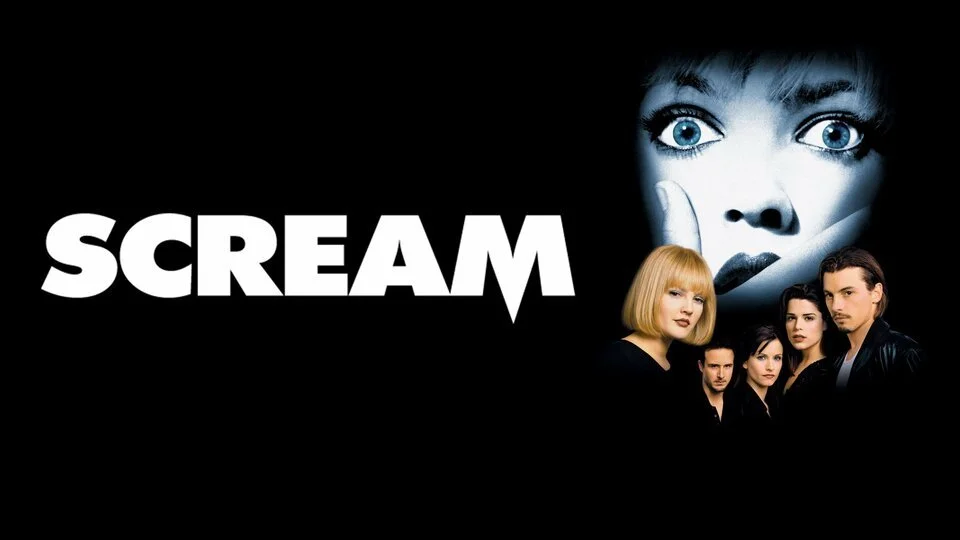
Drew Barrymore, Neve Campbell, Skeet Ulrich, Courtney Cox and David Arquette in Scream (1996)
If there’s a horror movie I love introducing people to for the first time, Scream is always the one that comes to mind. There’s something incredibly fun about watching a room full of people play along: guessing who the killer is, reacting to every fake-out, and just having a blast with it. It’s the kind of movie that thrives with an audience, where the experience becomes communal instead of isolated. I always think about the scene at Stu’s party, where Randy and the group are watching Halloween. That moment perfectly captures the vibe Scream creates: people watching a horror movie while unknowingly living inside one. It mirrors the exact feeling of watching Scream itself—especially with a crowd—where everyone is hyper-aware of the rules, the tropes, and the tension, yet still completely swept up in the ride.
If I’m being honest, there still hasn’t been an opening in horror more iconic than the first fifteen minutes of Scream. It’s bold, cruel, and instantly memorable, setting the tone not just for the film but for an entire era of horror that followed. Few films can genuinely claim to have changed the genre, but Scream didn’t just revive the slasher…it reinvented it. Released in 1996, at a time when horror had grown tired and predictable, Wes Craven’s Scream arrived sharp, self-aware, and unapologetically brutal, reminding audiences why the genre mattered in the first place.
From its now-iconic opening scene, Scream announces that it’s playing a different game. Drew Barrymore’s shocking fate immediately establishes the film’s central thesis: no one is safe, and the rules you think you know are about to be tested. Written with razor-sharp wit by Kevin Williamson, the script blends meta-commentary with genuine suspense, allowing the film to both critique and celebrate slasher conventions simultaneously. Characters openly discuss horror “rules,” yet the film constantly finds ways to subvert them, keeping viewers perpetually off-balance.
What truly elevates Scream is its balance of tones. The film is funny without becoming parody and scary without losing its intelligence. Wes Craven’s direction ensures that every joke is undercut by menace, every moment of levity shadowed by violence. Nothing ever feels throwaway—humor and horror are constantly working in tandem rather than competing with one another.
Ghostface isn’t just a killer; he’s a concept, an embodiment of horror fandom turned lethal. His introduction is exactly how you introduce an icon, and it’s no surprise that he has endured as one of the most important figures in pop-culture horror. There’s an immediacy to his presence that’s both unsettling and strangely playful, perfectly in line with the film’s self-aware tone.
The costume itself is deceptively simple, yet completely unforgettable. The black cloak and ghost mask—often associated with The Scream painting—create a look that feels both familiar and deeply unsettling. What is even more interesting is that the mask he wears was not created for the movie - it was actually manufactured by Fun World in 1991 as part of a “Fantastic Faces” series. It was also available in stores like Kmart and drugstores before the film’s release, so the image was already a public domain. This made it a remarkably cost-effective design, proving that an iconic horror villain doesn’t need excess or spectacle to leave an impact. It’s honestly hard to imagine Ghostface wearing anything else; the design feels so natural to the character that any alternative would seem unnecessary. That simplicity is part of what makes Ghostface so effective. He’s not flashy or overdesigned, he’s a silhouette, a presence, something that can appear anywhere, be anyone and instantly shift the tone of a scene. In a film so deeply aware of horror history, that restraint is what allows Ghostface to transcend the movie itself and become something larger: a symbol of the genre, its fans, and its enduring ability to scare, surprise, and entertain.
Neve Campbell’s Sidney Prescott stands as one of the genre’s most important final girls. She isn’t defined by helplessness, but by resilience, trauma, and an evolving sense of strength. Sidney’s emotional arc grounds the film, ensuring that Scream never drifts into hollow satire. No matter how self-aware the movie becomes, Sidney keeps it human.
The supporting cast only strengthens that foundation. Courteney Cox’s Gale Weathers brings ambition and bite, while Matthew Lillard’s unhinged energy as Stu Macher adds a layer of unpredictability that keeps the film constantly off-balance. Together, the ensemble feels alive and dangerous—like anyone could snap at any moment.
Spoiler warning from here on out.
The final reveal of Billy Loomis and Stu Macher as the killer duo is where the film truly takes the icing on the cake. Earlier in the movie, Billy is arrested and then released due to a lack of concrete evidence, seemingly clearing him as a suspect. He’s even stabbed by Stu after finally sleeping with Sidney—a moment the film frames as a narrative “reward” he’s been working toward the entire time. By that point, the movie has gone out of its way to convince you that there’s no possible way Billy could be the killer.
That’s what makes the reveal hit so hard. When Billy comes crashing out of the upstairs room and the truth is exposed—alongside Stu’s gleefully unhinged confession—the shock feels earned rather than cheap. The film plays directly with audience assumptions, weaponizing narrative logic against the viewer. It’s not just a twist; it’s a payoff for paying attention for the near 2-hour runtime.
The reveal recontextualizes everything that came before it, making the entire ride feel worthwhile. It’s bold, cruel, and perfectly in sync with Scream’s central idea: knowing the rules doesn’t protect you, it just makes the betrayal sting more.
Perhaps Scream’s greatest achievement is its legacy. It understands horror history while pushing it forward, influencing an entire generation of films that followed. Yet even three decades later, it hasn’t aged into nostalgia, it still works. The tension still lands. The kills are still shocking. The commentary still feels sharp. Scream is a five star film, no hesitation there. It isn’t just a great horror movie, it’s a smart, thrilling, and endlessly rewatchable landmark that proves the genre is strongest when it knows exactly what it’s doing… and dares you to keep up.
RATING:
⭐️⭐️⭐️⭐️⭐️